
I’ve always believed that bookstores tell you a great deal about a city. They reveal what it values, how much time it allows for wandering, and whether curiosity is encouraged or merely tolerated.
Bangalore, in many ways, is a city made for readers. Tucked between cafés, office buildings, and busy roads are bookstores that feel like small acts of resistance — spaces that ask you to slow down, browse, and stay awhile. I love them deeply. And yet, the older I get, the more I find myself wishing for something else alongside them: better, more accessible libraries.
Not everything we read needs to be owned.
Wandering through Bangalore’s bookstores
Church Street remains the city’s most familiar bookish artery. Blossom Book House is chaotic in the best possible way — narrow aisles, teetering stacks, and the joy of stumbling upon something you didn’t know you needed. It’s where you go when you want to rediscover the pleasure of accidental reading.
A few steps away, Higginbothams offers a very different rhythm. There’s history in its walls, a sense of continuity. Browsing here feels slower, more deliberate, almost ceremonial. It reminds you that reading once held a central place in public life.
Across the city, independent bookstores add another layer of richness. Atta Galatta, especially, has long been more than a bookstore. It’s a gathering place — for readings, conversations, children’s sessions, and quiet afternoons with coffee. Spaces like these don’t just sell books; they build communities around them.
Smaller bookstores like The Bookworm offer a quieter intimacy — curated shelves, second-hand finds, and recommendations that feel personal rather than algorithmic.
These places matter. They keep reading visible and alive in a city that’s always rushing somewhere else.
When loving books starts to feel heavy
And yet, there’s an uncomfortable truth we don’t talk about enough: books are expensive, and they accumulate.
Buying books can quickly become a habit that carries guilt — unread spines, shrinking shelf space, money spent on titles we meant to read someday. Many of us move cities, live in smaller homes, or simply don’t want our love for reading to turn into clutter.
I don’t want to stop buying books.
I just don’t want buying to be the only way to read.
There was a time when I had a collection of over 300 books- across genres, and age groups as well. When I was living on my own, the 2nd bedroom was dedicated to books- all lined up, with a comfortable chair and cushion. But then when time came to move out, they were baggage, a heavy one at that. I had read and enjoyed them, and knew i wanted them to go to others who should read/enjoy. Gave nearly all away to people and small school libraries, and now I hold on to about 30 books [ in Chennai] and 15 here with me. Some autographed, the entire Murakami collection and few other general topic based ones that I wish to hold on to.
Reading should feel generous and fluid, not transactional or burdensome.
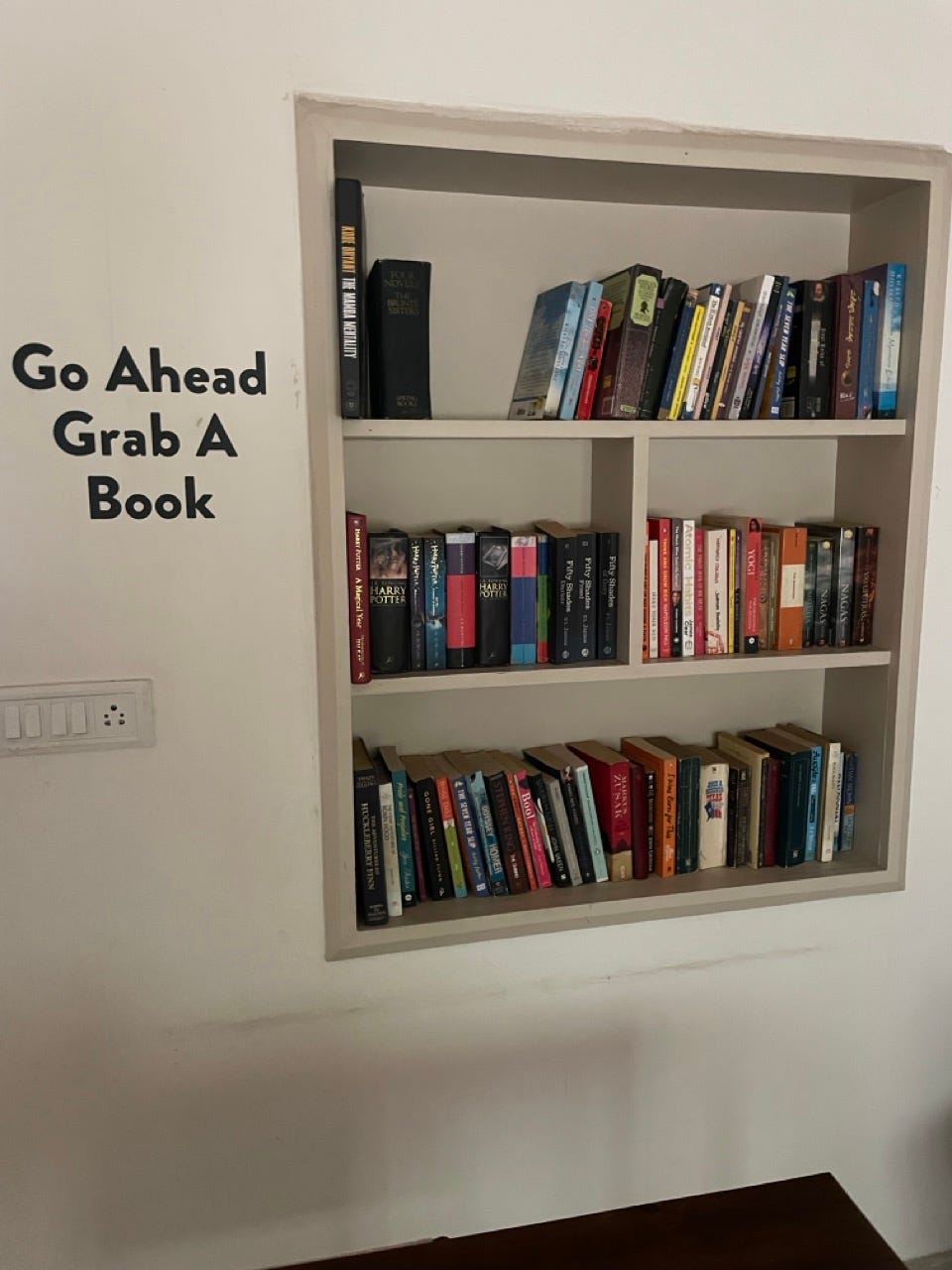
Love cafes that have a book/reading corner [this is The Peck, Koramangala]
Ramonas & Eloor, Chennai — a library that shaped how I read
When I lived in Chennai, I was a member of Ramonas & Eloor Lending Library, and I still miss it. Eloor had a fabulous, wide-ranging collection and a simple, reader-friendly system — a refundable deposit and the freedom to borrow widely.
It allowed me to read without accumulating. To experiment without committing. To follow curiosity wherever it led.
Eloor made reading feel democratic and light — a reminder that stories are meant to circulate, not sit permanently on personal shelves. The fact that such libraries struggle to survive today feels like a quiet cultural loss.
Bansa Library — taking books beyond urban privilege
{updated the post with this bit after the meetup last evening}
More recently, I came across Bansa Library through Twitter, where I connected with Jatin, one of the people behind the initiative. I later met the team in person in Bangalore, and what they’re building stayed with me.
Bansa creates free libraries in small villages — thoughtfully stocked, community-run, and steadily expanding. They take books to places where bookstores don’t exist and where access to reading has never been a given.
What struck me most was the intent. This isn’t about scale for vanity’s sake, but about access, dignity, and possibility. A free library can quietly transform a child’s relationship with learning. It can introduce adults to worlds they were never invited into before.
Initiatives like Bansa deserve far more support and visibility. If we truly believe reading changes lives, then free libraries should not be exceptions — they should be the norm.
If you wish to contribute, either become a patron or send books from the wishlist
What I wish for Bangalore — and beyond
I don’t dream of fewer bookstores. I dream of more choices.
Neighbourhood lending libraries.
Book-sharing spaces.
Affordable, community-run collections.
Reading without the pressure to own.
Bangalore already has a vibrant book culture. What it needs now is infrastructure that makes reading sustainable — for people with small homes, limited budgets, or simply a desire to read widely without accumulating endlessly.
A reader’s quiet hope
I will always love walking into bookstores, getting lost, and coming home with stories. But I also long for something lighter — the freedom to read without worry, without excess, without guilt.
I miss Eloor.
I admire Bansa.
And I hope we build a future where books move freely through hands and homes, reaching everyone who wants them.
Because a city — and a country — that makes reading accessible is one that chooses imagination, empathy, and thought


